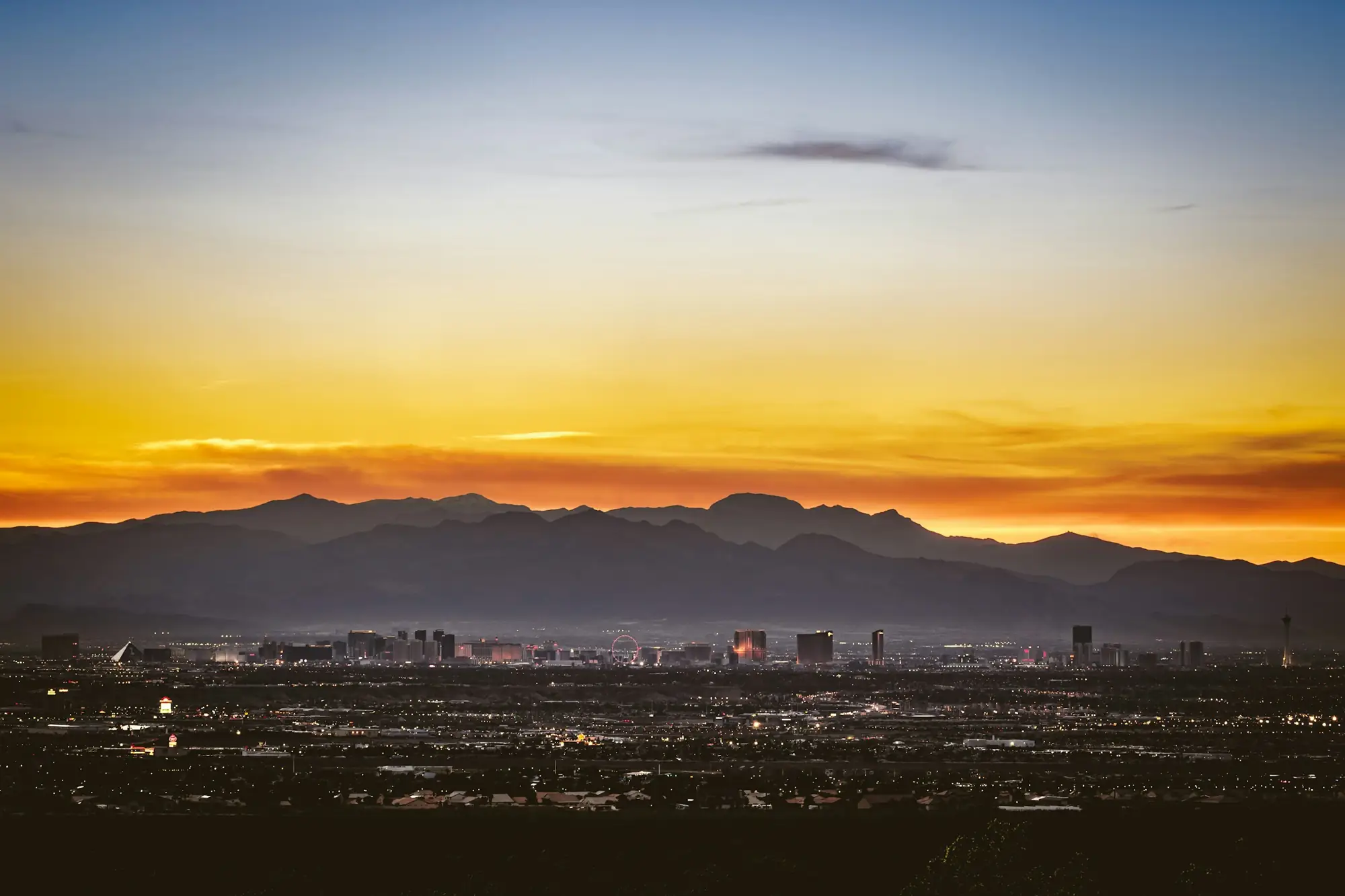
Living in Las Vegas comes with real pros and cons, and the people who are happiest after a move are usually the ones who weighed both columns honestly, not just the tax savings or the sunshine.
Below is the list I walk through with buyers who are relocating: the good, the hard, and the details that tend to matter most once the moving truck is gone.
Pro: Taxes and more home for the money
For many buyers, especially those coming from California, this is the headline. Nevada has no state personal income tax, so once you're a resident, your wages, retirement income and investment income aren't taxed at the state level. Property taxes have a built-in brake too: Nevada caps annual increases on an owner-occupied primary residence at 3%, as long as you claim that designation after you buy.
Housing is the other half of the equation. Compared with coastal California and other high-cost metros, most buyers find more square footage, and often a newer home, for their budget here. The gap is smaller compared with many inland markets, so run your own numbers instead of trusting a headline.
Two caveats: Nevada does charge sales tax, and summer power bills, HOA dues and insurance can eat into the savings. My California to Nevada tax calculator and the Las Vegas vs California cost of living breakdown help you see the full picture. For tax planning around a move, talk with a CPA.
Pro: Sunshine, mild winters and outdoor recreation
Las Vegas is one of the sunniest metro areas in the country, and the stretch from October through April is the reward for summer. Winter days are usually mild enough for golf, hiking and dinner on the patio, with only occasional cold snaps.
The outdoor options close to town are hard to beat:
- Red Rock Canyon National Conservation Area on the west edge of the valley, with a scenic drive, climbing routes and miles of trails
- Lake Mead National Recreation Area to the east, for boating, paddling and desert hiking
- Mount Charleston in the Spring Mountains, noticeably cooler in summer and home to the Lee Canyon ski area in winter
- Valley of Fire State Park, about an hour northeast, known for its red sandstone
Zion and Death Valley national parks are both within a half-day's drive, which makes long weekends easy. If outdoor access is driving your search, the west side near Red Rock and the Henderson foothills toward the lake are good places to start. My Summerlin vs Henderson comparison covers both.
Pro: Airport access, entertainment and newer homes
The airport. Harry Reid International Airport sits a few miles from the Strip and is a reasonable drive from most of the valley. Because it serves so many visitors, it offers a long list of nonstop destinations. If you travel for work or fly back often to see people, that's a real quality-of-life perk.
Entertainment. Shows, concerts, restaurants and major events are part of everyday life here, not just vacation. The valley has the NFL's Raiders, the NHL's Golden Knights and the WNBA's Aces, plus a dining scene that extends well beyond the resorts. Most daily life happens away from the Strip, in neighborhood restaurants, parks and community centers.
Newer housing. Much of the valley was built in the last few decades, and master-planned communities keep adding homes. That means modern floor plans, energy-efficient construction and more choice in new construction than many relocating buyers are used to.
Con: How hot does Las Vegas get in summer?
There's no sugarcoating it. From roughly June through September, triple-digit highs are routine, and nights can stay very warm. Dry heat is easier to tolerate than humid heat, but a July afternoon here is still intense.
What that means day to day:
- Outdoor activity shifts to early mornings and evenings for several months.
- Air conditioning is essential, and summer electric bills run far higher than spring or fall bills.
- Car interiors, pavement and outdoor furniture get hot enough to burn, and garages and attics bake.
- Summer monsoon storms can bring sudden wind, blowing dust and heavy rain.
Adapting is a lot like adapting to a northern winter: you plan around it, and a drive up to Mount Charleston helps. When you shop for a home, the A/C system's age, shade, insulation and window quality matter more here than almost anywhere. I cover what to check in owning a home in the desert: pools, solar and water.
Con: Water, drought and desert landscaping rules
Southern Nevada gets the vast majority of its water from the Colorado River through Lake Mead, a river system under long-term drought stress. The region has responded with strict conservation rules:
- Watering schedules. Landscape irrigation is limited to assigned days that change by season.
- Less grass. State law bars using Colorado River water on decorative, nonfunctional turf at properties not zoned exclusively for single-family homes, which is why HOA common areas and streetscapes have been converting to desert landscaping.
- Desert-style yards. Newer homes typically come with rock and drip-irrigated plants rather than lawns, and rebates have encouraged older homes to convert.
For homeowners, this mostly means a desert-style yard and some rules to follow. Because water used indoors is treated and returned to Lake Mead, conservation efforts focus on outdoor use. If a big green lawn matters to you, know that the valley is moving firmly in the other direction.
Con: Sprawl, car dependence and HOAs everywhere
Sprawl. The valley spreads across a wide basin, and most neighborhoods were designed around the car. There's bus service, but outside the urban core you'll likely drive for nearly everything. Where you live relative to work matters a lot, especially if your commute crosses the valley at rush hour. My Las Vegas relocation guide starts with the commute for exactly this reason.
HOAs. Homeowners associations are the norm in neighborhoods built over the last few decades, and many master plans layer a master association over a sub-association. HOAs maintain parks and common areas and enforce design standards, but they also bring monthly dues, approval requirements for exterior changes and rules about parking, rentals and yards. Some newer areas add a SID or LID assessment on top.
If you want to avoid an HOA entirely, your choices narrow to older central neighborhoods and some rural-zoned or custom-home pockets. I explain the layers in Las Vegas HOA, SID and LID fees explained.
Con: An economy tied to tourism
Tourism, gaming, conventions and hospitality are the engine of the Southern Nevada economy. That brings jobs and steady investment, but it also means the region feels national downturns hard. When travel dropped during the late-2000s recession and the 2020 shutdowns, local employment and the housing market took a bigger hit than in many more diversified metros.
The economy has broadened over time, with growth in fields like healthcare, logistics and construction, but the tourism link hasn't gone away. In practical terms:
- If your income depends on hospitality, it's worth keeping a bigger cushion than you might elsewhere.
- If you work remotely or in a less cyclical field, the cycles matter less to your paycheck, though they can still move home values in the short run.
- Buy a home you can comfortably hold through a downturn, not one that only works if prices keep rising.
Las Vegas pros and cons at a glance
| Pros | Cons |
|---|---|
| No state personal income tax; 3% cap on primary-residence property tax increases | Triple-digit summers from roughly June through September |
| Sunny, mild winters | High summer A/C bills |
| Red Rock, Lake Mead and Mount Charleston close by | Water limits and desert landscaping rules |
| Busy airport with many nonstop routes | Spread-out layout; you'll drive nearly everywhere |
| Plenty of newer homes and new construction | HOAs, and sometimes SIDs, in most newer neighborhoods |
| Shows, dining and pro sports | An economy sensitive to tourism cycles |
Dana's tip: Test-drive the city before you commit. Visit in July or August, not just in spring, and drive your likely commute at rush hour. If you still love it after that, you'll probably love it year-round.
Then spend time in two or three areas that fit your budget. The neighborhood quiz is a quick way to narrow the list, and I'm glad to help you compare specific neighborhoods once you have a short list.
Frequently asked questions
Is Las Vegas a good place to live?
It depends on what you value. Las Vegas offers no state personal income tax, mild winters, quick airport access, outdoor recreation and plenty of newer homes. In exchange, you accept hot summers, water conservation rules, a car-dependent layout, widespread HOAs and an economy tied to tourism. The best test is to visit in summer, drive your commute and spend time in the neighborhoods you're considering before you buy.
How hot does it get in Las Vegas in the summer?
Very hot. Triple-digit highs are routine from roughly June through September, and nights can stay warm. The heat is dry, which many people find easier than humidity, but it still shapes daily life: outdoor activity moves to mornings and evenings, and air conditioning is essential. When you buy, look closely at the A/C system's age, the home's shade and insulation, and a summer month's electric bill.
Does Las Vegas have water restrictions?
Yes. Most of the valley's water comes from the Colorado River through Lake Mead, and landscape watering is limited to assigned days that change by season. State law also bars using Colorado River water on decorative grass at properties not zoned exclusively for single-family homes. Most newer yards use desert landscaping with drip irrigation, so expect rock and desert plants rather than a big lawn.
Are there neighborhoods in Las Vegas without an HOA?
Yes, but they're the minority. Homes without an HOA are mostly in older central neighborhoods and some rural-zoned or custom-home areas. Most homes built over the last few decades belong to at least one association, and many master-planned communities have two. If avoiding an HOA matters to you, tell me at the start and I'll filter the search from day one.