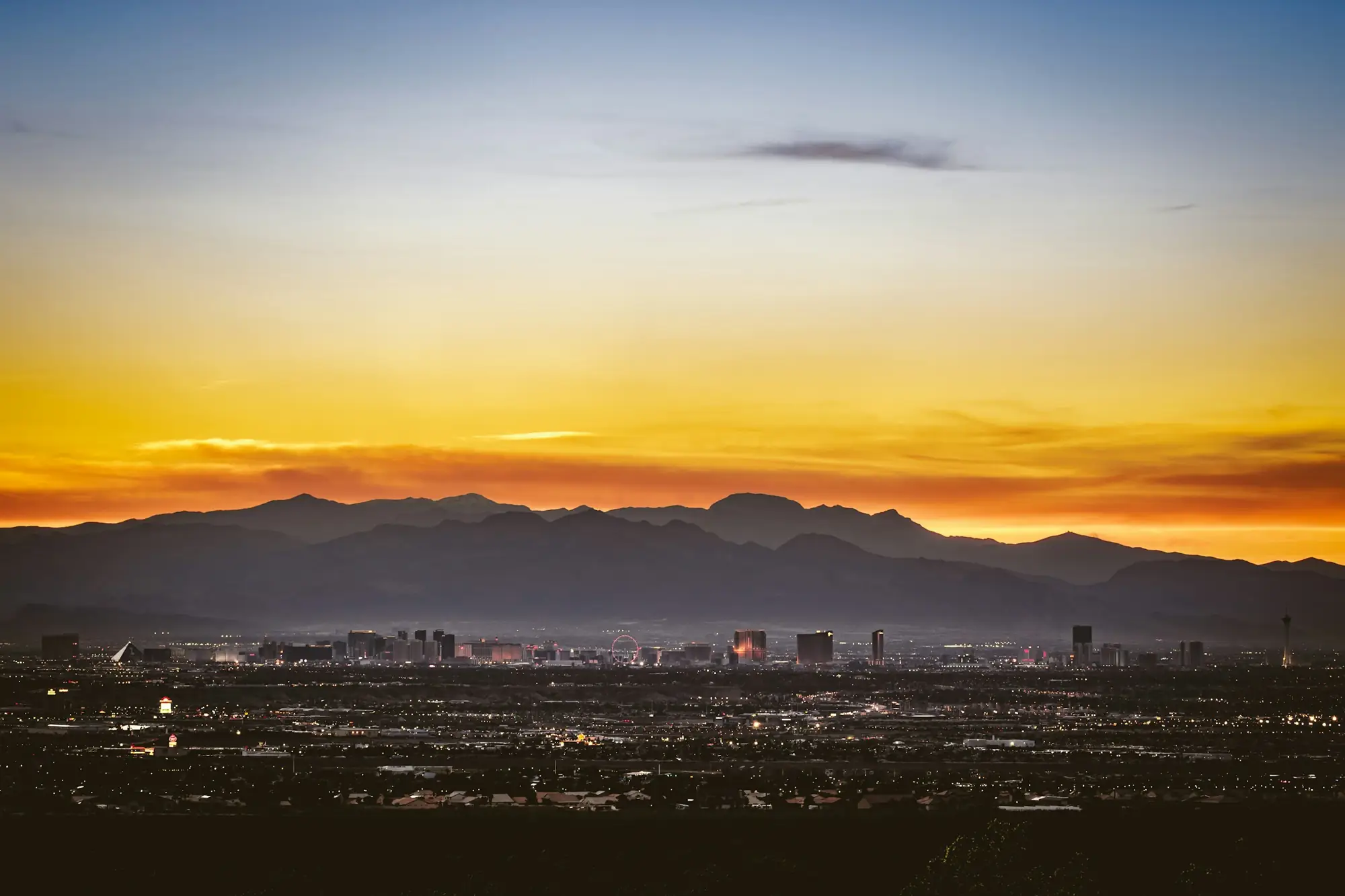
Moving to Las Vegas from Los Angeles is a relocation I help with constantly, and it has its own rhythm. You aren't cutting ties with Southern California so much as moving them a few hours up I-15, so the real questions are practical: how rough is the drive back, what actually changes with taxes and HOAs, how hard is the heat, and which part of the valley works best if you'll still spend weekends in LA.
This post sticks to the LA-specific pieces. For the statewide playbook, including Prop 13 and how to time a California sale against a Nevada purchase, read my guide to moving from California to Las Vegas.
The I-15 drive from Los Angeles to Las Vegas
Almost every LA-to-Vegas trip funnels onto I-15. From the basin you pick it up near Ontario or Rancho Cucamonga, climb the Cajon Pass into the High Desert, pass Hesperia and Victorville, then cross the long, open stretch of the Mojave through Barstow and Baker. After the climb over Mountain Pass, you reach the Nevada state line at Primm, and from there it's a straight run north into the south end of the valley.
With clear roads, plan on roughly four to five hours, and longer if you start on the Westside or in the South Bay rather than the eastern suburbs. A few habits make the drive easier:
- Fuel and water. Services thin out between Barstow and the state line, so top off before the empty stretch and keep water in the car from spring through fall.
- Heat on your car. Summer afternoons in the Mojave are hard on tires, batteries and cooling systems. A quick check before a July drive is cheap insurance.
- Wind and weather. Gusty crosswinds are common in the Cajon Pass and across the desert, and winter storms can slow or occasionally close the mountain passes. Check conditions before you leave.
- Moving day. If you're driving a loaded truck or towing, skip summer afternoons and the Friday and Sunday rush. A midweek, early-morning start is far easier.
Weekend trips back to LA: traffic, timing and flying
The drive is easy to plan. The traffic is what catches people. Friday afternoons and evenings fill I-15 heading toward Vegas, and Sunday afternoons bring the well-known crawl back toward California, with backups commonly building near the state line and again on the approach to the Cajon Pass. Holiday weekends and big event weekends in Las Vegas make both worse.
Clients who go back and forth regularly tend to settle into one of a few patterns:
- Shift the days. Leave Thursday night or Saturday morning, and come home Monday morning instead of Sunday afternoon.
- Go early. A pre-dawn Sunday departure can beat the worst of the southbound traffic.
- Fly. The flight is about an hour, and Harry Reid International Airport has nonstop service to LAX and several other airports around Southern California. For a short visit, flying often wins once you count traffic.
Two logistics points shape where you buy. The south end of the valley puts you on I-15 within minutes, which trims every drive to California. And if you'll fly often, the airport sits in the south-central valley, so the southwest valley, Green Valley and west Henderson keep that trip short. Las Vegas is on Pacific time, too, so calls with LA colleagues and friends don't shift at all.
Dana's tip: Before you commit to a neighborhood, time the drive from its front gate to the I-15 southbound on-ramp at the hour you'd usually leave for LA. Ten extra minutes across the valley is nothing once, but it adds up over dozens of trips a year.
Is the Brightline West high-speed train actually happening?
Brightline West is a planned high-speed rail line between Las Vegas and Rancho Cucamonga, running about 218 miles largely within the I-15 corridor. The California end would connect with Metrolink, High Desert stops are planned in Hesperia and the Victor Valley, and the Las Vegas station is planned on Las Vegas Boulevard south of the Strip. The project broke ground at the Las Vegas station site in April 2024.
Here's where it stands as I write this in September 2026. Early civil construction is underway along the route, and the company's target for opening has slipped to late 2029 after it originally aimed for the 2028 Los Angeles Olympics. Cost estimates have climbed, and the company is still working to secure a large federal loan to complete its financing. That's a project in progress, not a sure thing on a fixed date.
My advice: treat the train as a possible bonus, not a reason to buy. Choose a home that works with the I-15 drive and the flight as they exist today. If the line does open, the southern half of the valley would sit closest to the Las Vegas station, which is one more point in that area's favor if you travel to Southern California often.
Taxes, HOAs and paperwork: what changes after the move
Income tax. Nevada has no state personal income tax, which is the headline for most LA households. California still expects a part-year return for the year you leave, and it can keep taxing California-source income afterward, such as rent from a property you keep or a gain on a California sale. When your residency actually changes depends on your facts, so have a CPA map out your move before you set dates. I'm not a tax advisor; this is the list I'd bring to one.
Property tax. Your Prop 13 basis stays in California. Here, the Clark County Assessor sets a taxable value, and an owner-occupied primary residence gets a 3% cap on annual property-tax increases, as long as you claim that designation after you buy.
HOAs. If you're leaving an older LA neighborhood with no association, this is the biggest adjustment. Most newer Las Vegas neighborhoods have an HOA, often a master association plus a sub-association, and the CC&Rs can limit things LA buyers care about: parking a boat or trailer for Lake Mead weekends, storing off-road toys, exterior changes and renting the home out. Some newer areas also carry a SID or LID assessment that works a lot like Mello-Roos. My guide to HOA, SID and LID fees shows how to spot them.
Paperwork. Since October 1, 2025, Nevada law has required a written brokerage agreement between a buyer and their agent, so expect to sign one with me early in the process. Once you're a resident, you'll also have 30 days to get a Nevada driver's license and register your vehicles.
Heat, sun and space: how daily life changes
How hard the heat hits depends on where in LA you're leaving. From the beach cities, a Las Vegas summer is a genuine shock: highs regularly top 100 degrees from roughly June into September, and midsummer nights stay warm. From the San Fernando Valley or the Inland Empire, it will feel familiar, just drier and a bit longer. Late summer can bring monsoon thunderstorms with sudden wind, dust and downpours, while winters are mild with cool nights and the occasional frost.
The climate changes what a good house looks like here:
- A covered patio and a backyard that faces north or east stay usable on summer afternoons.
- The age and efficiency of the A/C matter more than almost any kitchen finish.
- Dual-pane windows, shade trees and solar screens all show up on the electric bill.
- Desert landscaping and drip irrigation are the norm, and outdoor watering follows a seasonal schedule.
Space for the money. I won't quote numbers that will be stale next month, but the pattern is consistent: compared with most of LA, buyers typically find newer and larger homes here, with attached two- and three-car garages and plenty of single-story floor plans. The surprise is the lot. Newer subdivisions often put a big house on a compact lot, so if you want room for a pool, an RV or a workshop, we'll target older neighborhoods or larger-lot pockets on purpose.
Where LA buyers often look in Las Vegas, and why
I match neighborhoods to the property and logistics you need, but a handful of areas come up again and again with buyers who will keep spending time in Southern California.
| Area | What draws LA buyers | Logistics |
|---|---|---|
| Southern Highlands | Guard-gated golf neighborhoods, a wide range of home sizes, mountain views | Right off I-15 at the south end; quick to the airport |
| Mountain's Edge | A newer master plan with parks, trails and Exploration Peak | Blue Diamond Road and the 215 reach I-15 in minutes |
| Enterprise | Newer homes and ongoing construction in the south-central valley | Close to I-15, the airport and the planned train station area |
| Inspirada and Seven Hills | West Henderson: a newer park-centered master plan and established, rolling streets | St. Rose Parkway and the 215 connect quickly to I-15 |
| Summerlin | Master-planned villages, an extensive trail system, Red Rock Canyon nearby | Farther from the I-15 on-ramp toward California; the 215 gets you there |
| High-rise condos | Lock-and-leave living near the Strip | Simple for buyers who split time between LA and Las Vegas |
Many LA buyers narrow the choice to the west side versus the southeast before picking a neighborhood. Once you know which side of the valley fits your commute and your trips back, the shortlist gets much easier.
My advice for an LA-to-Las Vegas move
- Plan a scouting trip that includes a weekday, so you see real traffic and can drive your likely commute.
- Visit once in summer if you can. A July afternoon tells you more about a backyard than any listing photo.
- Time the drive from each finalist neighborhood to the I-15 on-ramp toward California and to the airport.
- Talk to a CPA before you pick a move date or a closing date on either side.
- Ask for HOA documents early and read the parking, rental and architectural rules.
- Get homeowners insurance quotes for the specific address instead of assuming your California premium carries over.
Not sure which side of the valley fits? Start with my neighborhood quiz, then reach out to me and I'll build a tour that groups your top areas so one trip from LA covers them all.
Frequently asked questions
How long does it take to drive from Los Angeles to Las Vegas?
With clear roads, most of the LA area is roughly four to five hours from Las Vegas on I-15, depending on where you start. Traffic can stretch that a lot, especially on Sunday afternoons heading back to California, when backups build near the state line and the Cajon Pass. Leaving early, traveling midweek or flying, which takes about an hour in the air, are the usual workarounds.
When will the Brightline West train from Las Vegas to Southern California open?
As of September 2026, Brightline West was targeting late 2029 for service between Las Vegas and Rancho Cucamonga, where riders would connect to Metrolink. Construction began in 2024, but the opening date has already slipped once and the company was still working to finish its financing. I'd treat the train as a possible bonus, not a reason to choose one home or neighborhood over another.
Which Las Vegas neighborhoods work best for frequent trips to LA?
For frequent drives, look at the south end of the valley, where Southern Highlands, Mountain's Edge and Enterprise put the I-15 on-ramp toward California minutes away. Those areas, along with Green Valley and west Henderson, also keep the airport close for quick flights. Summerlin and the northwest add time to both trips. My Mountain's Edge guide is a good place to start.
Are HOAs common in Las Vegas?
Very. Most neighborhoods built in the last few decades have an HOA, and many master-planned communities have both a master association and a sub-association. Dues vary widely, and guard-gated communities usually cost more. Read the governing documents before you buy, especially the rules on RV and boat parking, exterior changes and rentals. My HOA, SID and LID guide explains what to check.
Is Las Vegas hotter than Los Angeles?
Yes, noticeably so in summer. Las Vegas highs regularly top 100 degrees from roughly June into September, and nights stay warm in midsummer, though the air is much drier than on the coast. If you're coming from the San Fernando Valley or the Inland Empire, the heat will feel more familiar. Winters are mild, with cool nights and occasional frost, and spring and fall are the most comfortable seasons.